






Choose Your Province/State of Service

In order to serve you better, please select your Enbridge Gas location services.

Choose Your Province/State of Service

We noticed you are visiting from Utah, would you like to visit our Utah site?

Continue to Utah's site

Or please select your province/state of your choice so we can display the correct content for your location?

Choose Your Province/State of Service

In order to serve you better, please select your Enbridge Gas location services.

is currently
selected

Go to this state's site Stay on this state's site

Choose Your Province/State of Service

We noticed you are visiting from Utah, would you like to visit our Utah site?

is currently
selected

Leading Ontario’s Energy Future

As Ontario’s energy landscape evolves, Enbridge Gas is committed to an “all-of-the-above” approach—integrating natural gas, renewables, and innovative solutions like hydrogen blending to deliver reliability, affordability, and sustainability. Hydrogen offers new possibilities for storing, transporting, and using energy efficiently, helping to reduce greenhouse gas (GHG) emissions across the province. Through our leadership in advancing alternative fuels and collaborating with municipal, agricultural, industrial, and transportation partners, Enbridge Gas is helping shape Ontario’s energy future.


How hydrogen supports a cleaner energy future

Blending

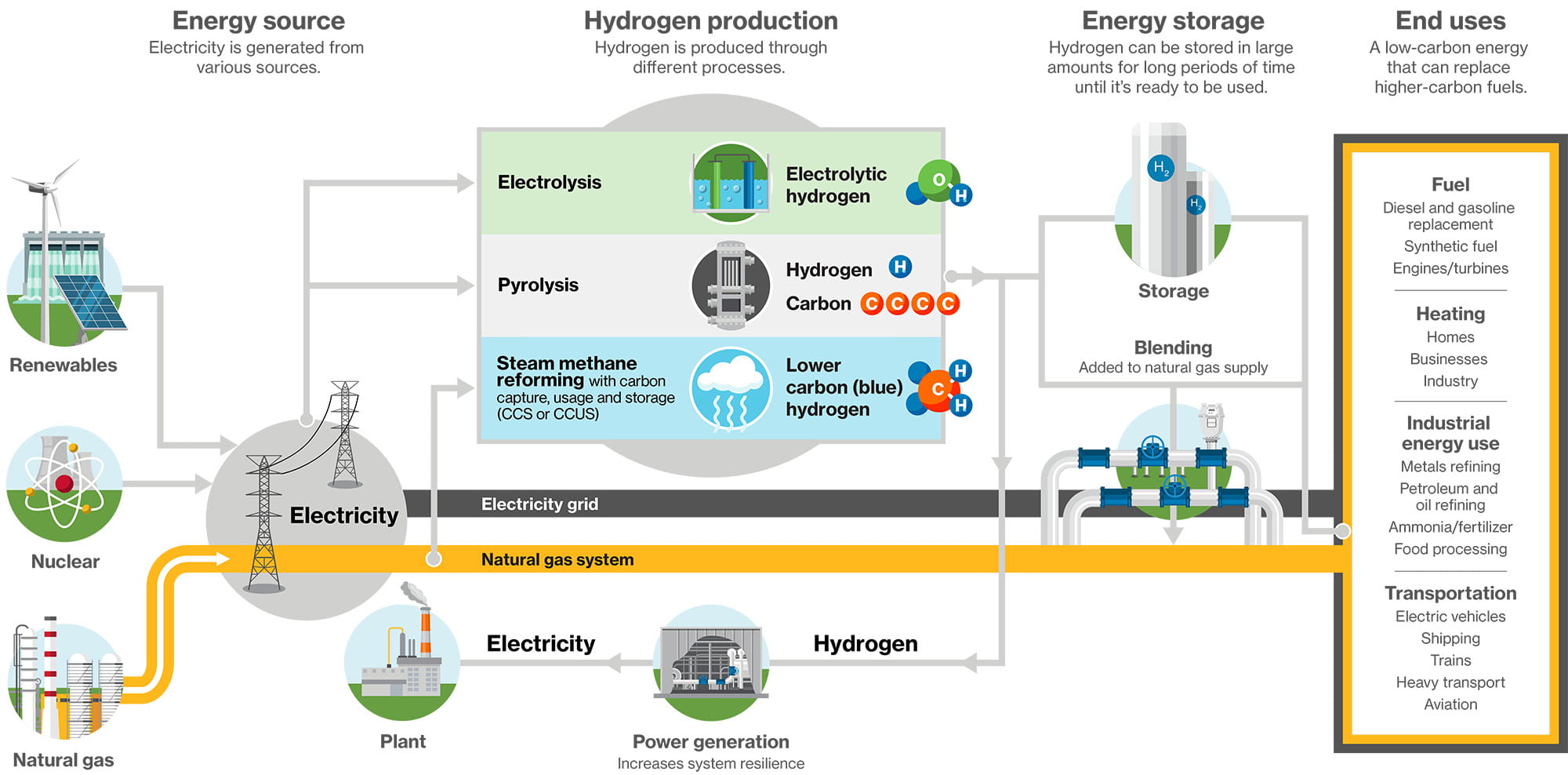
Hydrogen can be safely blended into Ontario’s natural gas supply to displace its use.

Storage

Electricity can be converted into hydrogen and, like natural gas, stored year-round on a large scale for reliability and stability.

Connecting systems

Enabling the natural gas system and electricity grid to work together, hydrogen supports resiliency and helps balance Ontario’s energy supply and demand.

Replacing higher-carbon fuels

Hydrogen can replace carbon-based fuels used for heavy-duty transportation and industrial processes.


What makes hydrogen a cleaner energy alternative? It comes down to how it’s made

Power-to-Gas (PtG) is a process in which electrical energy is converted to hydrogen through the electrolysis of water. If only renewable sources of electricity are used, the hydrogen produced is called renewable. If hydrogen is produced from a mix of renewables and other sources, it’s considered low carbon.*

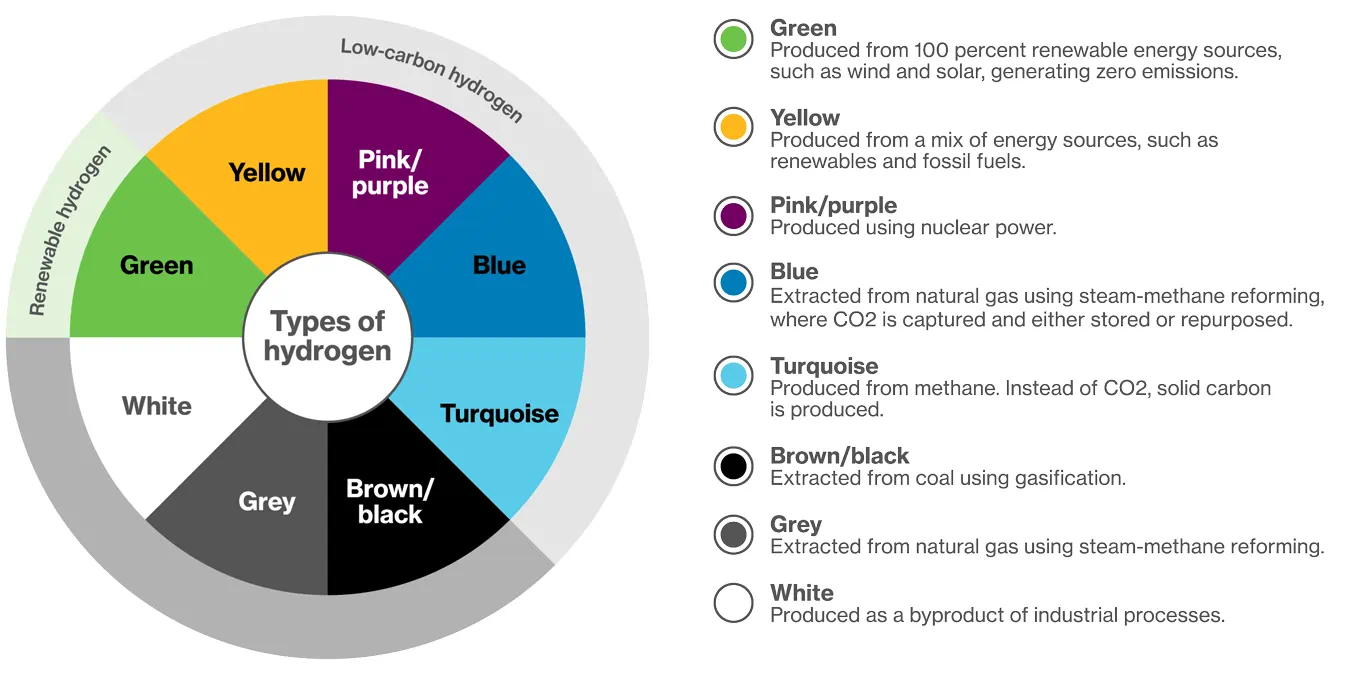
Most of today’s hydrogen is created using steam methane reforming (SMR), a process that separates hydrogen from methane. If the carbon emissions are captured and safely stored, the hydrogen produced is considered low carbon, or blue.

Like electricity, hydrogen is a flexible energy carrier. Unlike electricity, it can be more easily stored than electrical energy, and turned back into electricity when required.


Low-carbon and renewable hydrogen

While describing hydrogen types using colour is common, the terminology is not standardized and can cause confusion. This is why the industry is moving towards a simpler classification, using terms such as low-carbon and renewable hydrogen.


Driving Innovation to Meet Ontario’s Growing Energy Needs

As Ontario’s communities and industries continue to grow, Enbridge Gas is investing in advanced energy solutions to support reliable service, economic development, and customer choice. These hydrogen initiatives demonstrate how new technologies can help strengthen Ontario’s energy system and provide practical benefits for homes, businesses, and transit.

North America’s first utility-scale power-to-gas facility

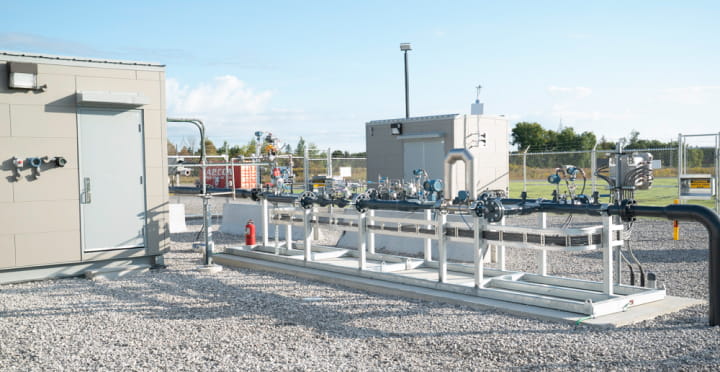
Located in Markham, Ontario, Canada, the Power to Gas facility can converts electrical energy from renewable sources into hydrogen, which can then be blended into the natural gas system to help balance Ontario’s electricity supply and demand.

Hydrogen blending project–the first of its kind in North America

Enbridge Gas is currently providing a blend of hydrogen and natural gas to 4,400 customers in Markham, Ontario as part of a pilot program to validate the reduction of carbon in our natural gas system.

MiWay hydrogen fuel cell electric bus pilot

Enbridge Gas worked with Mississauga Transit, CUTRIC, Cummins, Ballard, New Flyer, and all three levels of government to potentially deploy ten hydrogen fuel cell electric buses in the city of Mississauga.


What are potential areas of opportunity for hydrogen?**

Industry

  • Cement
  • Steel
  • Energy
  • Chemicals
    • Ammonia
    • Methanol
  • Other industries

Transport

  • Heavy-duty transport
  • Shipping
  • Aviation
  • Rail
  • Light-duty transport

Buildings

  • Heating

** Office of Fossil Energy, United States Department of Energy. Hydrogen Strategy: Enabling a Low-carbon Economy.


Read Canada’ s Hydrogen Strategy 2024 Progress Report

See the ambitious framework for actions that will cement hydrogen as a tool to help achieve net-zero emissions while creating jobs, growing our economy and protecting our environment.

Energy for generations

Explore Ontario’s Energy for Generations plan, a long‑term approach to using the province’s full energy system – electricity, natural gas, hydrogen, storage and other energy sources – to build a stronger, more competitive, and more self‑reliant provincial economy.

Ontario’s low-carbon hydrogen strategy

See Ontario’s plans to become a cleaner manufacturing hub, with new investments in hydrogen that will facilitate the production of clean steel, electric vehicles (EV) and the batteries that power them while generating fewer emissions.

Learn more about renewable hydrogen’s potential

We can help identify opportunities for municipalities, industry and more.


More hydrogen resources

Canadian Hydrogen Association (CHA)

About their work

Hydrogen Business Council

Join the conversation

Frequently asked questions

Zero emission vehicles are vehicles that release no tailpipe air pollution. Examples include battery electric vehicles, which are recharged with electricity,  and hydrogen fuel cell vehicles, which run on electricity from a fuel cell using compressed hydrogen. To learn more about zero emission vehicles, visit Zero-emission vehicles (ZEV) - Washington State Department of Ecology

Yes. Safety is always the top priority at Enbridge Gas. Hydrogen is non-toxic and non-poisonous, and when handled properly, it can be safely blended into the natural gas system. Enbridge Gas has decades of experience operating over 150,000 km of pipelines and a strong track record of providing safe, reliable service. Natural gas remains one of the safest fuels in use today, and our commitment to safety extends to all new technologies, including hydrogen blending.

Enbridge Gas began blending up to two percent hydrogen by volume into the natural gas system as part of a pilot project. This approach builds on similar initiatives in North America and Europe and was launched in 2021 after extensive study and preparation to ensure safety and reliability.

In a measured amount, hydrogen blends seamlessly into the existing natural gas system, with no changes to reliability or the quality of service. You’ll continue to be able to heat your home and water safely. The amount at which Enbridge Gas is blending hydrogen will have no adverse effects on your certified appliances.

Approximately nine to twelve litres of water is used to produce one kilogram of hydrogen and about eight kilograms of oxygen.

Ontario’s Made-in-Ontario Environment Plan, released November 2018, commits the province to reducing greenhouse gas emissions to 30 percent below 2005 levels by 2030, in line with Canada’s 2030 target. As part of the plan, the province has developed a low-carbon hydrogen strategy. The strategy establishes a vision for a new hydrogen economy that will address climate change and air quality while creating opportunities for industry to grow. Enbridge Gas, along with other participants across Canada, contributed to developing this strategy.

Read Ontario’s hydrogen strategy.

Read Canada’ s Hydrogen Strategy 2024 Progress Report.

* The Government of Canada offers a Clean Hydrogen Investment Tax Credit to hydrogen producers who can achieve a lifecycle carbon intensity of less than 4 kg of carbon dioxide equivalents per kg of hydrogen produced.
instituteforenergyresearch.org/international-issues/eia-expects-energy-demand-to-increase-almost-50-percent-worldwide-by-2050/
https://www.energy-transitions.org/publications/making-clean-hydrogen-possible/