






Choose Your Province/State of Service

In order to serve you better, please select your Enbridge Gas location services.

Choose Your Province/State of Service

We noticed you are visiting from Utah, would you like to visit our Utah site?

Continue to Utah's site

Or please select your province/state of your choice so we can display the correct content for your location?

Choose Your Province/State of Service

In order to serve you better, please select your Enbridge Gas location services.

is currently
selected

Go to this state's site Stay on this state's site

Choose Your Province/State of Service

We noticed you are visiting from Utah, would you like to visit our Utah site?

is currently
selected

What is Carbon Capture and Storage (CCS)?

CCS represents technologies that can be applied to industrial facilities or the atmosphere to capture the greenhouse gas carbon dioxide (CO2) for reuse or storage preventing its release into the atmosphere.1

Capture and storage of CO2 is recognized by the Government of Canada as a critical component of climate action that can help sectors including cement, steel, energy, and fertilizer transition to net-zero.1

Further, CCS is an essential element in Canada’s 2030 Emission Reduction Plan to help Canada meet greenhouse gas emission reduction goals.

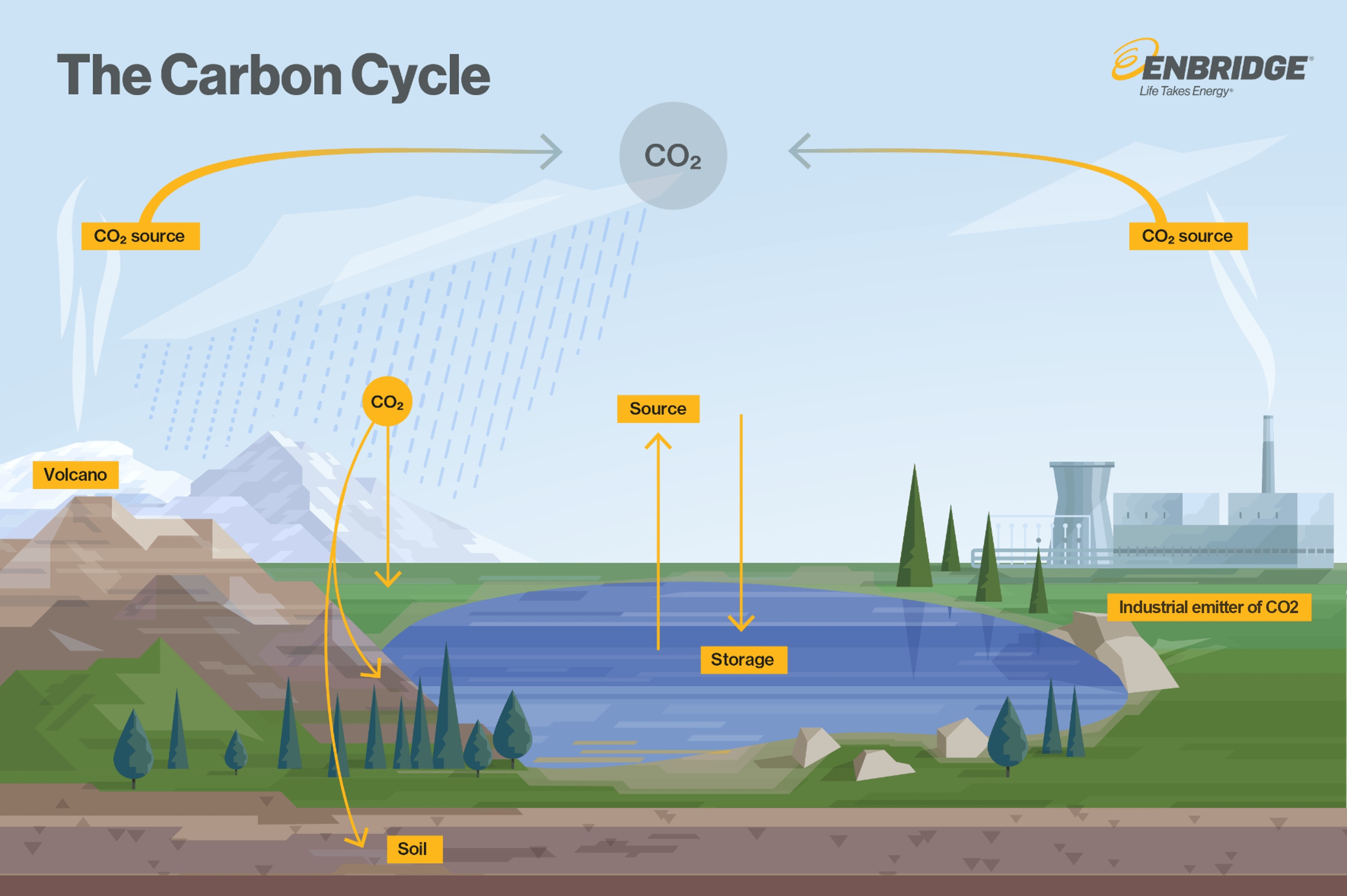
Courtesy of the Global CCS Institute

Why is it important?

  • Although carbon naturally cycles through the air, water, and land, human activities have accelerated the release of carbon into the air (as CO2) from the consumption and use of natural resources.2
  • Efforts to reduce CO2 emissions are being made around the world to address climate change.3
  • CCS helps decarbonize industrial processes including CO2 emissions from hard to abate industries like cement, steel, energy, fertilizer and chemical sectors.4

How it works

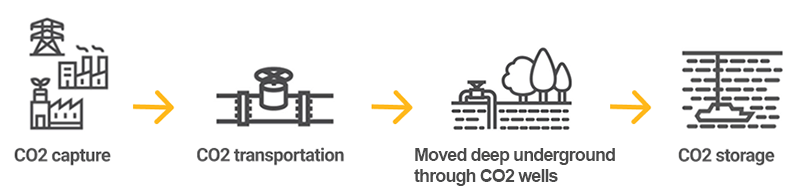
Looking at the process of CCS, the CO2 is captured and compressed at the source, moved through a pipeline and then put underground through a well, into permanent storage spaces deep underground.

A diagram to illustrate the carbon capture process, from CO2 capture, CO2 transportation, moved underground through CO2 wells to CO2 storage. Measurement, monitoring and verification throughout the entire process.

Learn about the process of CCS

  • Carbon capture technologies are an essential element within a suite of measures that can help to stop harmful CO2 emissions from entering the atmosphere.1
  • Carbon capture processes reduce most of the CO2 produced from being released into the atmosphere and either re-uses it or stores it underground.1

More information:

  • After capture, CO2 is dried and compressed, it is typically moved via new, purpose built pipelines to an injection site.1 Depending on distances and quantities, it may also be moved by truck, rail or ship.
  • Canada currently has five CO2 pipeline systems which have been in operation for more than two decades.5

More information:

CO2 is injected underground through specially constructed wells. The wells safely deliver the CO2 deep below the surface of the earth and are monitored to ensure integrity and CO2 containment.

Working with leading subsurface experts, CO2 storage sites are carefully selected through a robust technical analysis of:

  • surface location
  • depth
  • containment
  • capacity
  • injectivity

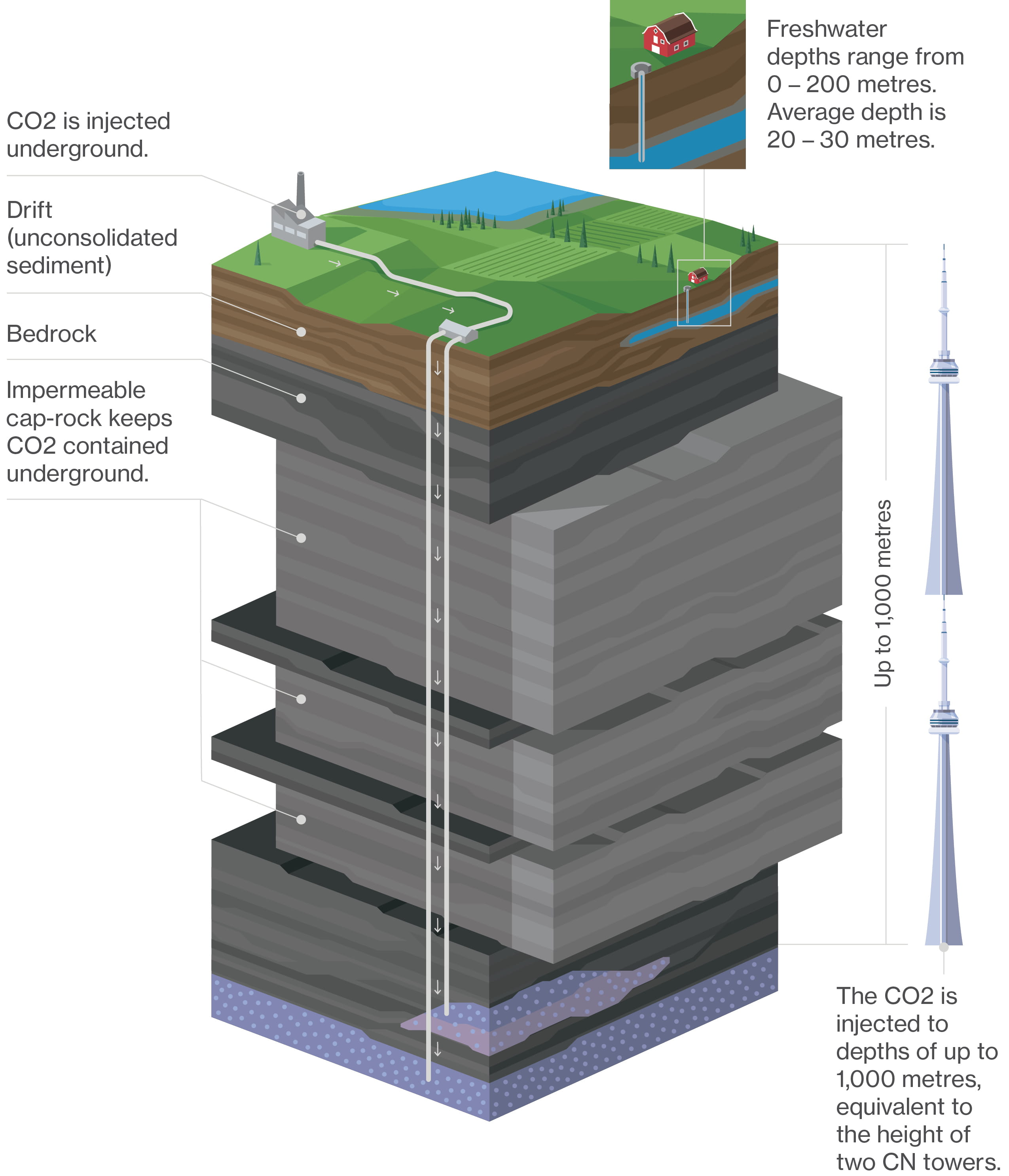
CO2 is stored far below groundwater supplies, in appropriate geological formations that contain impermeable cap rock above porous rock formations. Pressurized CO2 permeates microscopic spaces in the storage reservoir and becomes permanently sequestered or stored via natural chemical and geologic processes.6

To learn more about choosing a CO2 storage location, please see our fact sheet.

CO2 storage in Ontario

  • The government of Ontario has implemented a roadmap, including legislation and supporting regulations, to regulate geologic carbon storage in Ontario.
  • The above ground wellhead gravel pad for a CO2 injection well or monitoring well is quite small - about 8m x 8m.
  • CO2 could be injected and stored in reservoirs deep underground (up to 1,000 metres or ~ 3,300 feet) under unconsolidated sediment, bedrock and impermeable cap-rock far away from potable (drinking) using special wells and buried pipelines.
  • Many naturally occurring layers of rock cover the storage formations which helps to prevent CO2 from moving to the surface.
An illustration to explain how carbon capture and sequestration works

An important part of CCS involves measurement, monitoring and verification (MMV).

MMV uses various technologies to monitor CO2 storage sites and surrounding areas. MMV confirms that CO2 is securely contained deep underground and not affecting water sources, land, or wildlife.

Please see our fact sheet to learn more about CO2 storage – measurement, monitoring and verification.

How we ensure safe operations​

The safety of communities, and protecting the environment, will always be our top priority.​

Read more:

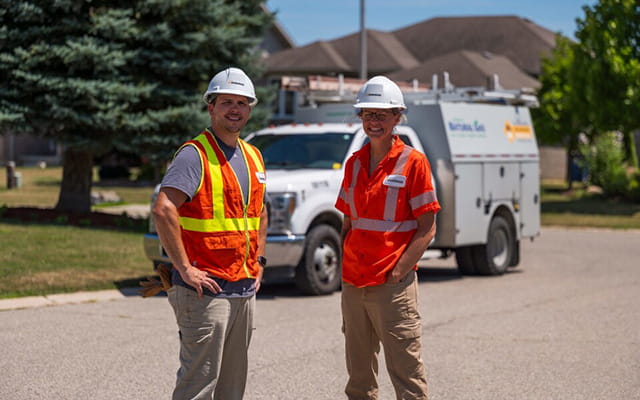
Two people wearing safety vests and helmets

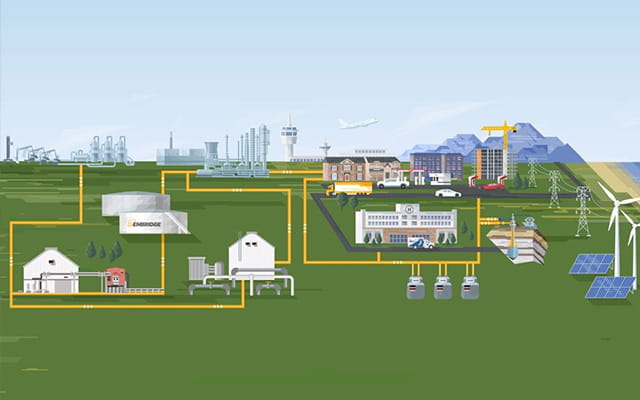
Our energy infrastructure and value chain

Energy heats homes. It cooks food. It powers industry. It empowers society. It helps build and shape the world around us. At Enbridge, we deliver the energy that fuels quality of life.

Read more:

A graphics showing Enbridge's energy infrastructure

Preparing for the energy future

We strive to make an impact along the entire energy value chain. We do this by modernizing our assets, investing in renewable power and innovative solutions like renewable natural gas, hydrogen, and carbon capture, utilization and storage, and we are working with our customers to encourage energy efficiency.​

Enbridge is developing cutting-edge, innovative solutions to help prepare for the energy transition.​ We are committed to meeting the growing energy needs of the future while reducing emissions.​

Two people standing next to a blue wall with a signage Technology + Innovation Lab

CCS: a growing global enterprise

Meeting global climate goals will require a significant expansion of carbon capture and storage. CCS enables industries to reduce emissions while transforming operations into low‑carbon opportunities—supporting economic growth, creating jobs, and accelerating progress toward net zero.

86
commercial facilities operating worldwide7
66
new facilities under construction7
877
projects in various stages of development7
A global with map pins for Canada, China, Japan, The European Union, United Kingdom and United States

1 See Natural Resources Canada’s Carbon Management Strategy
2 See Environment and Climate Change Canada’s Greenhouse Gas Emissions: Canadian Environmental Sustainability Indicators
3 See The United Nations Net-Zero Coalition
4 See Government of Ontario’s Geologic Carbon Storage
5 See Canada Energy Regulator’s Market Snapshot Release date: 2024-05-01, Accessed October 2024
6 Standards and guidelines for carbon capture, utilization and storage
7 IEA, CCUS Projects Database, report as of Apr 2026

Additional resources:
CCS Knowledge Centre
Global CCS Institute
CO2 Capture, Utilization and Storage (CCUS) - Natural Resources Canada

Disclaimer:
This webpage includes information and data related to Enbridge’s ESG goals and sustainability-related activities, commitments, and plans, or statements about the environmental benefits of our business activities or effects of our business on climate change. Enbridge’s ESG goals and sustainability-related activities, commitments, and plans, and associated information and data, involve forward-looking information and are based on a variety of assumptions, estimates, judgments, risks, and uncertainties. The achievement of our ESG goals and sustainability-related commitments will depend on the collective efforts and actions across a wide range of stakeholders, and the development of technologies, all of which are largely outside of our control, and there can be no assurance that they will be achieved. Our ESG goals and pathways for reducing our operational emissions over time continue to evolve and may need to be restated, modified, or recalibrated as available data improves, as standards, methodologies, metrics and measurements mature, and as legislation, regulations, policies, and stakeholder sentiment evolve.