






Oct. 1, 2026
The Ontario Energy Board (OEB) has approved changes to the rates Enbridge Gas charges its customers effective Oct. 1, 2026. These new rates will remain in effect from Oct. 1, 2026 through Dec. 31, 2026 and include any applicable temporary charges and credits.
Please visit our residential rates or business rates sections to view the rates specific to your location.
Yes, on Oct. 1, 2026, Enbridge Gas changed the rates our customers pay. Residential customers who buy natural gas from Enbridge Gas will see either an increase or a decrease in their natural gas bills, depending on their location and consumption.
The bill impacts are primarily the result of:
- Forecast natural gas prices, which have decreased relative to July 2026 QRAM forecasts across most purchase locations.
- A weaker Canadian dollar relative to the U.S. dollar, which affects the cost of natural gas purchased on behalf of customers.
- Adjustments for differences between the forecast and actual costs of natural gas supply, transportation, storage and delivery from prior periods.
Residential customers will see decreases ranging from about $11 to $29 per year, or 1.0% to 2.8%, while customers in Union South will see an increase of about $18 per year, or 1.9%. The overall impact of these changes will depend on how much gas you use and whether you purchase your gas from a gas marketer.
There continues to be a small facility carbon charge (0.0145 cents/m3) included in the “Delivery to You” line on your bill. This charge is associated with industrial emitter costs to operate Enbridge Gas’ facilities that deliver natural gas to you. For the average residential customer, the facility carbon charge represents about 32-35 cents per year, depending on your location. This is not the same as the Federal Carbon Charge, which was removed from Enbridge Gas customer bills effective April 1, 2025.
Enbridge Gas buys natural gas and gas transportation services for our customers from the market and we pass any costs to customers without mark-up. Delivery and storage rates are reviewed and approved by the Ontario Energy Board, which conducts an open review process with participation from consumer groups and Ontario municipalities.
Please visit our residential rates section to view the rates specific to you and the area where you live.
Gas costs – Gas commodity costs include information on the “Gas Supply Charge” and “Cost Adjustment” lines on your bill. The net natural gas rate reflects what we expect to pay for gas supplies and transportation services during the next year as well as any adjustments to make up the difference between our forecast cost for gas and actual costs from prior periods. Also, in the Union South rate zone (Rate M1 and M2), the cost of transportation to Ontario is included in the “Gas Supply Charge”.
Transportation costs – Transportation costs include information on the “Transportation to Enbridge” and “Cost Adjustment” lines on your bill and reflect the cost of transporting natural gas into Ontario from its North American sources.
Transportation costs vary depending on where you live due to changing fuel prices, pipeline tolls and available capacity on pipelines serving different parts of Ontario. For customers in the Union South zone (Rate M1 and M2), the transportation cost is included in the “Gas Supply Charge” line on your bill.
Delivery costs – Delivery costs include information on the “Delivery to You” line on your bill and reflect the cost of delivering natural gas to your home or business as well as an adjustment to make up the difference between our forecast and actual delivery rates from prior periods, through our safe and reliable distribution system. This charge also includes a facility carbon charge which is associated with the costs to operate Enbridge Gas’ facilities to deliver natural gas to you. Storage and load balancing costs are also included in the “Delivery to You” line item and reflect the cost of storing natural gas so it is available when you need it.
Customer Charge – The customer charge partially covers the cost of maintaining a safe and reliable natural gas distribution system. It includes things like meter reading, customer services and 24-hour emergency response.
Rate Adjustment – There is an adjustment for the difference between forecasted and actual costs from a prior period reflected in this QRAM filing. Customers may also see a separate, one-time OEB-approved adjustment associated with previously approved deferral and variance account balances.
The October bill impacts include a one-time clearing of 2024 Utility Earnings and Disposition of Deferral and Variance Account balances. Most customers will see this adjustment on their October bill. For Union South Rate M1 customers, the adjustment will be spread evenly over three months.
Because natural gas is a commodity, market prices can fluctuate with changes in supply and demand. Enbridge Gas adjusts customer prices every three months to reflect market changes. While forecast natural gas prices have decreased overall, customer bills are affected by a combination of factors, including natural gas supply costs, transportation costs, cost adjustment riders and other OEB-approved rate components. These factors vary by rate zone. As a result, most residential customers will see decreases, while customers in Union South and some business rate zones will see increases.
Once a year, Enbridge Gas adjusts customer delivery rates to reflect the expected costs to deliver natural gas safely and reliably to Ontario homes and businesses. The OEB approved the fair and reasonable regulated distribution, transmission and storage rates that Enbridge Gas will charge customers in 2026 to recover the costs of serving our customers safely and reliably.
The federal carbon charge was removed from Enbridge Gas customer bills effective April 1, 2025.
A facility carbon charge is included in the delivery or transportation charge on the bill. This charge is associated with the costs to operate Enbridge Gas’ facilities that deliver natural gas to you. In January, there was an increase in the facility carbon charge from 0.0123 cents/m3 to 0.0145 cents/m3. For an average residential customer, this increase represented about 32-35 cents annually, depending on your location.
There is an adjustment for the difference between forecasted and actual costs from a prior period reflected in this QRAM filing. Customers may also see a separate, one-time OEB-approved adjustment associated with previously approved deferral and variance account balances.
The October bill impacts include a one-time clearing of 2024 Utility Earnings and Disposition of Deferral and Variance Account balances. Most customers will see this adjustment on their October bill. For Union South Rate M1 customers, the adjustment will be spread evenly over three months.
Enbridge Gas buys natural gas at a number of market supply hubs in Western Canada and the U.S. We pay market prices for natural gas and then pay other pipeline companies to transport the gas from supply hubs into our distribution system in Ontario. We adjust the rates we charge our customers for these items quarterly to reflect changes in market prices, which are passed through to our customers without mark-up. In addition, there are adjustments for the difference between our forecast for natural gas and natural gas transportation market prices, storage and distribution costs and the actual costs from prior periods.
The rates we charge customers for natural gas and gas transportation services are based on a forecast of the prices we expect to pay to buy these items from the market. Because the actual market costs can differ from our forecasts, adjustments are sometimes made quarterly (Jan. 1, April 1, July 1 and Oct. 1) to either refund or collect the difference so that you only pay the actual costs for these services and nothing more. Any costs are passed on to customers without any mark-up, subject to OEB review and approval.
Enbridge Gas sets rates based on a forecast of the costs we expect to pay for natural gas supplies and transportation and then adjusts rates for the actual costs each quarter. Different areas of the province are served by a different mix of natural gas transportation pipelines and gas supply sources, and as such, the costs for Enbridge Gas to buy gas supplies and transportation services from the market vary by location. In addition, the costs to build and maintain a distribution pipeline system varies by geographic location for several reasons including different soil conditions (e.g. rockier soil in the north), population density and the distance between homes/businesses and the need for and timing of infrastructure expansions and maintenance. Any cost differences are reflected in the four geographically based rate zones.
You’ll see two general types of natural gas rate changes during the calendar year. The first type occurs quarterly, on the first of January, April, July and October, to reflect changes in what Enbridge Gas expects to pay for gas commodity and transportation services, as well as differences between forecast and actual costs for prior periods. This is shown as a change in the gas commodity and transportation rates on your bill and may also appear as a small change in delivery rates as Enbridge Gas also uses natural gas to power our delivery system. These changes, which are passed through to you without mark-up, help ensure that you’re billed at a rate that closely reflects the expected market price of gas.
The second type of rate change occurs annually and reflects the overall costs to run a safe and reliable natural gas distribution system. This may include a change in the delivery or storage rates, or the customer charge, depending on your location.
All rate changes are approved by the Ontario Energy Board.
EMPP spreads your forecasted yearly natural gas costs into 12 monthly payments to avoid fluctuating bills with the seasons, making it easier on your budget. We take your gas use history, expected gas rates and weather forecasts to estimate your yearly gas use. We then divide your estimated yearly gas use into 12 installment payments. Your bill every month is your installment payment as well as any “Other Enbridge Charges”, if applicable. We’ll review your plan periodically to make sure you’re on track and adjust your installment amount if needed. At the end of your plan, the EMPP balance should be nearing $0. While we do our best to ensure that your gas charges and EMPP installment match closely, any cost difference that exceeds the average monthly billing will roll over the balance due to the following year’s equal monthly payment plan.
If you buy natural gas and/or transportation services from an energy marketer, the price you pay for your gas supplies and/or transportation depends on the terms of the contract and is excluded from this rate change. If you have questions about their charges, please contact them directly at the number found on your bill. For other services purchased from Enbridge Gas (natural gas transportation, storage and delivery), residential customer rate changes depend on your location.
Natural gas is a highly reliable energy source and is cost-effective for many home and business owners, especially as affordability continues to be a top priority in energy decisions.
Enbridge Gas is committed to helping homes and businesses manage their gas bills. Enbridge Gas offers a range of energy-conservation information and programs that can help you lower your natural gas use and save money. See our upgrade and rebate programs.
If you have concerns about paying your bill, support is available:
Enhanced payment plans. If more time is needed to pay a balance, you can arrange to make installment payments against a balance and avoid late payment fees and disconnection.
Low income energy assistance plan (LEAP). Low-income customers having trouble paying their bill may qualify for emergency relief through LEAP. The program provides emergency relief with financial grants of up to $650 per calendar year for eligible low-income customers. This amount is applied directly to the outstanding balance on a customer’s gas bill and will vary based on account circumstances. Customers can visit the United Way Simcoe Muskoka website for qualification information.
Equal monthly payment plan (EMPP). Many households spend the most amount of money on natural gas during the three coldest months of the year. In the summer, they spend the least. The EMPP divides your expected yearly natural gas costs into monthly payments to minimize bills that fluctuate with the seasons, making it easier on your budget.
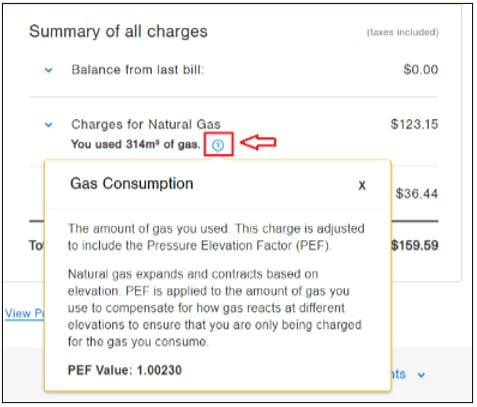
The pressure elevation factor (PEF) is a value that helps ensure accurate billing. Natural gas expands when the atmospheric pressure is low and contracts when it's high. Atmospheric pressure changes depending on land elevation. However, meters that measure natural gas consumption don't always adjust for atmospheric pressure.
PEF is applied to the amount of gas you use to compensate for how gas reacts at different elevations to ensure you are only being charged for the gas you consume.
Your pressure elevation factor (PEF) can make your energy bill go up or down.
Here are two examples of how it works, based on average household usage. The exact amount will depend on your specific usage.
- A household that uses 2,400 cubic metres of gas annually in Toronto has a PEF of 1.0057. This means their consumption will increase by approximately 14 cubic metres annually.
- A household that uses 2,400 cubic metres annually in Barrie will have a PEF of 0.9904. This means their consumption will go down by approximately 23 cubic metres annually.
The pressure elevation factor (PEF) value for your account can be found on the lower right-hand corner of the first page of your gas bill or through My Account by clicking on the question mark next to the amount of gas used under the Charges for Natural Gas.